
Silicon steel, also called silicon lamination, is a ferro silicon soft magnetic alloy with very low carbon content. People use it in slitter knife components.
It typically has a silicon content of 0.5 to 4.5%.
It is mainly used to make iron cores for transformers, motors, and generators.
Adding silicon can increase resistivity and maximum permeability, while reducing coercivity, core loss, and magnetic aging.
In some tooling sectors, a slitter knife benefits from silicon steel properties.
According to the manufacturing process and purpose, electrical steel is divided into three categories: hot rolled silicon steel, cold-rolled electrical steel and special purpose silicon steel.
Non-oriented silicon steel
Ferro silicon alloy with very low carbon content, In the deformed and annealed steel sheet,its crystal grains are distributed randomly. The silicon content of the alloy is 1.5% to 3.0%. or the sum of the silicon ad aluminum content is 1.8% to 4.0%. The products are usually supplied in coils of cold-rolled plates or strips, with common thicknesses of 0.35 and 0.5mm, which are mainly used to manufacture motors and generators
Oriented silicon steel, also called cold rolled transformer steel, is an important ferro silicon alloy used in the transformer (iron core) manufacturing industry. Cold rolled oriented silicon steel is mainly used to make transformer cores. The common thicknesses of cold rolled oriented silicon steel sheets for transformers are 0.20, 0.30, 0.35, and 0.50 mm, and their silicon content is generally high. slitter knife
During the processing of silicon steel sheet, the original lattice structure is destroyed, affecting transformer steel performance.
Therefore, it is necessary to improve shear quality, reduce burrs, and enhance the flatness of the silicon steel sheet.
Also apply appropriate clamping force to the core column when using a slitter knife.
Material selection
1.tungsten carbide
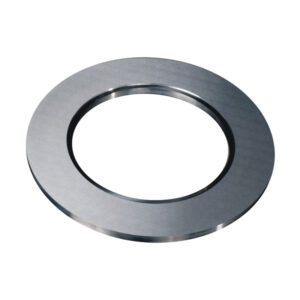
Circular slitter knife for cutting silicon steel is mainly made of high-quality tungsten carbide, such as YG15.
Additionally, YG11 and YG20 are also used.
The incision is smooth and the cutting edge is very sharp.
It is suitable for cutting all kinds of thin plates along a slitting line.
They can produce ultra-large circular knives with outside diameters smaller than 500 mm.
Outside diameter smaller than 300 mm.
The thickness tolerance can reach 0.001 mm.
2.HSS like W6Mo5Cr4V2
HSS is also a good choice for cutting silicon steel,more details please refer to HSS slitter knives for industrial cutting
3.tungsten carbide insert
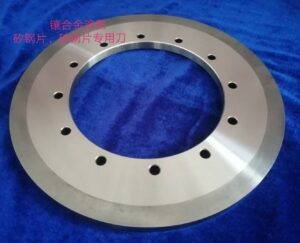
Due to the overall carbide cost is very high and the solid carbide knives are hard to regrinding,many company use unique inlay carbide technology.it is making the cemented carbide inlay on the low-carbon steel knife body, which can not only maintain the original performance of the cemented carbide.but also has low toughness of carbon steel so as to regrind easily. the hardness of the cutting edge can reach to HRA 88-90,and the durability is 5-10 times of HSS slitter knives.
Conclusion:Why the ultimate knife material selection is carbide
Overall, tungsten carbide offers high hardness and wear resistance. It also provides heat and corrosion resistance, making slitter knife components durable.
Additionally, it offers good strength and toughness.
In particular, its high hardness and wear resistance remain essentially unchanged at 500°C.
It can retain high hardness at 1000°C.